Research
Explore the scientific areas to which the Strickland Laboratory contributes.
Research Interest
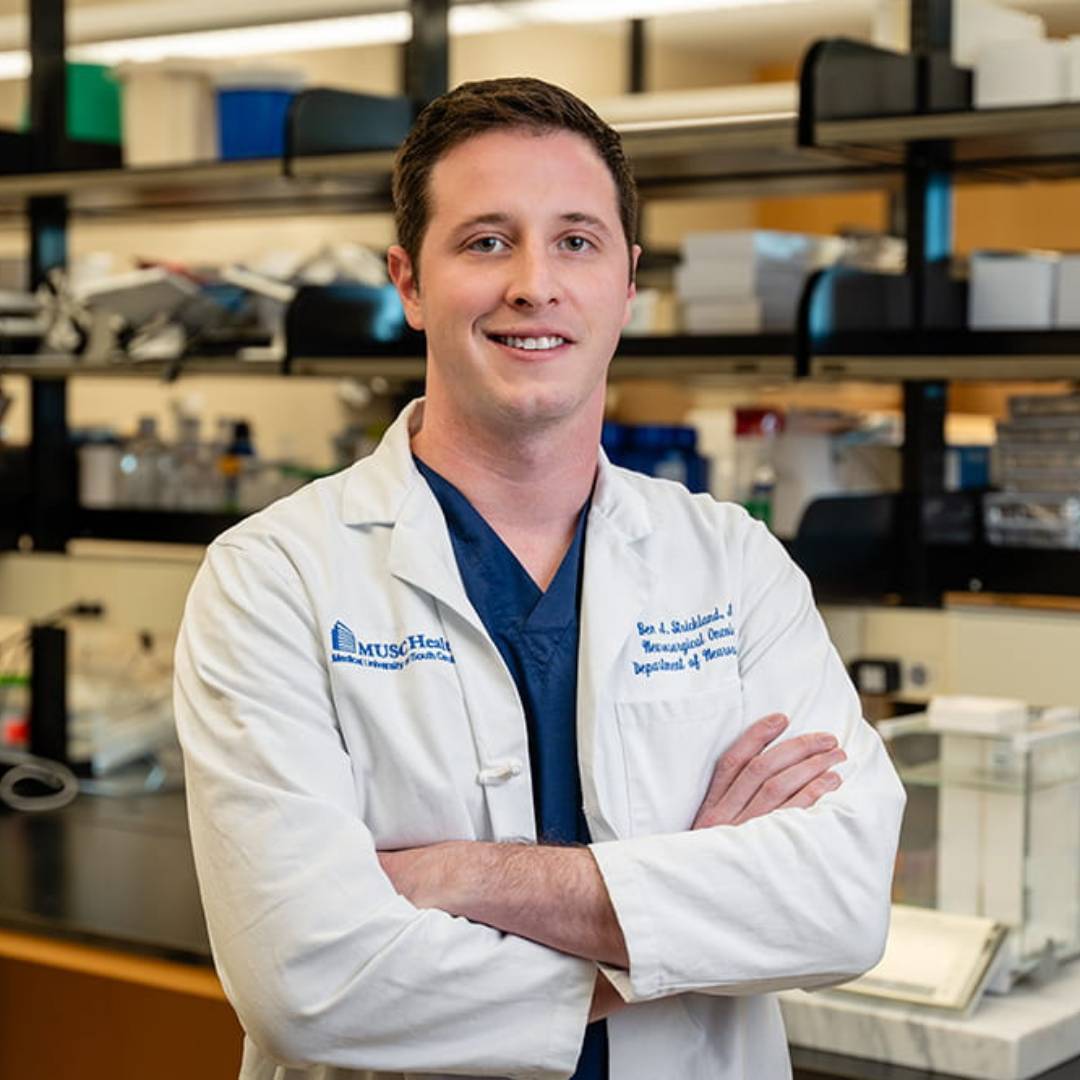
I am a neurosurgeon-scientist with a keen interest in the molecular underpinnings responsible for the malignant transformation of meningioma. My goal is to synergize my clinical practice with laboratory investigations towards the development of precise immunotherapies to combat this highly prevalent, yet understudied tumor.
— Ben Strickland, MD
Active Research Areas
Glioblastoma Immunotherapy & Tumor Microenvironment
Our lab investigates the immunosuppressive tumor microenvironment (TME) in glioblastoma, with a focus on tumor-associated macrophages (TAMs). We study how GBM manipulates myeloid cell populations to evade immune detection and clearance, with the goal of identifying actionable therapeutic targets. This work integrates single-cell analysis, spatial transcriptomics, and functional assays to map resistance mechanisms and develop novel immunotherapy strategies.
Targeted Immunotherapy for Aggressive Meningioma
Meningioma is the most common primary brain tumor, yet treatment options for aggressive, recurrent forms remain limited. Our laboratory investigates the differential epigenetic expression patterns that drive malignant transformation in meningioma. We aim to translate these molecular insights into precise immunotherapies for patients with tumors not amenable to surgical or radiation-based interventions.
Focused Ultrasound for Brain Tumor Treatment
Focused ultrasound (FUS) is a noninvasive energy delivery technology capable of precisely modulating the tumor microenvironment through acoustic waves. Our lab engineers FUS approaches to transiently open the blood-brain barrier, enhance drug delivery, and activate anti-tumor immune responses in glioblastoma. We investigate how FUS parameters can be optimized for maximal therapeutic effect while preserving healthy tissue.
CAR-T Cell Therapy for Glioblastoma
Chimeric antigen receptor (CAR) T-cell therapy represents a promising frontier in GBM treatment. Our research evaluates current clinical insights, addresses challenges such as antigen heterogeneity and the immunosuppressive microenvironment, and explores engineering approaches to enhance CAR-T persistence and function within the central nervous system.
Endoscopic & Minimally Invasive Skull Base Surgery
Leveraging advanced endoscopic and minimally invasive neurosurgical techniques, we refine surgical approaches for skull base tumors including pituitary adenomas and meningiomas. Our work focuses on improving resection rates, reducing complications, and characterizing long-term outcomes through multi-institutional collaboration.
Positions & Appointments
2023–Present
Assistant Professor, Department of Neurosurgery
Medical University of South Carolina, Charleston, SC
2022–2023
Fellow, Skull Base and Cerebrovascular
Department of Neurosurgery, Emory University, Atlanta, GA
2021–2022
Fellow, Skull Base and Neuro-Oncology
Department of Neurosurgery, University of Southern California, Los Angeles, CA
2015–2021
Resident Physician
Department of Neurosurgery, University of Southern California, Los Angeles, CA
2013–2015
Research Associate
Department of Neurosurgery, MD Anderson Cancer Center, Houston, TX
Education
Residency · June 2022
Neurological Surgery
University of Southern California, Los Angeles, CA
Fellowship · June 2021
Skull Base & Neuro-Oncology
University of Southern California, Los Angeles, CA
MD · May 2015
Medicine
Baylor College of Medicine, Houston, TX
BA · May 2011
Economics
Clemson University, Clemson, SC
BA · May 2011
Biology
Clemson University, Clemson, SC